Systems Structural Biology Group

Active Projects

A shared view of ongoing research, current progress, and project teams.

Active Projects

10

Research Areas

5

Team Members

10+

Partner Sites

Multi-site

ActiveInvestigation

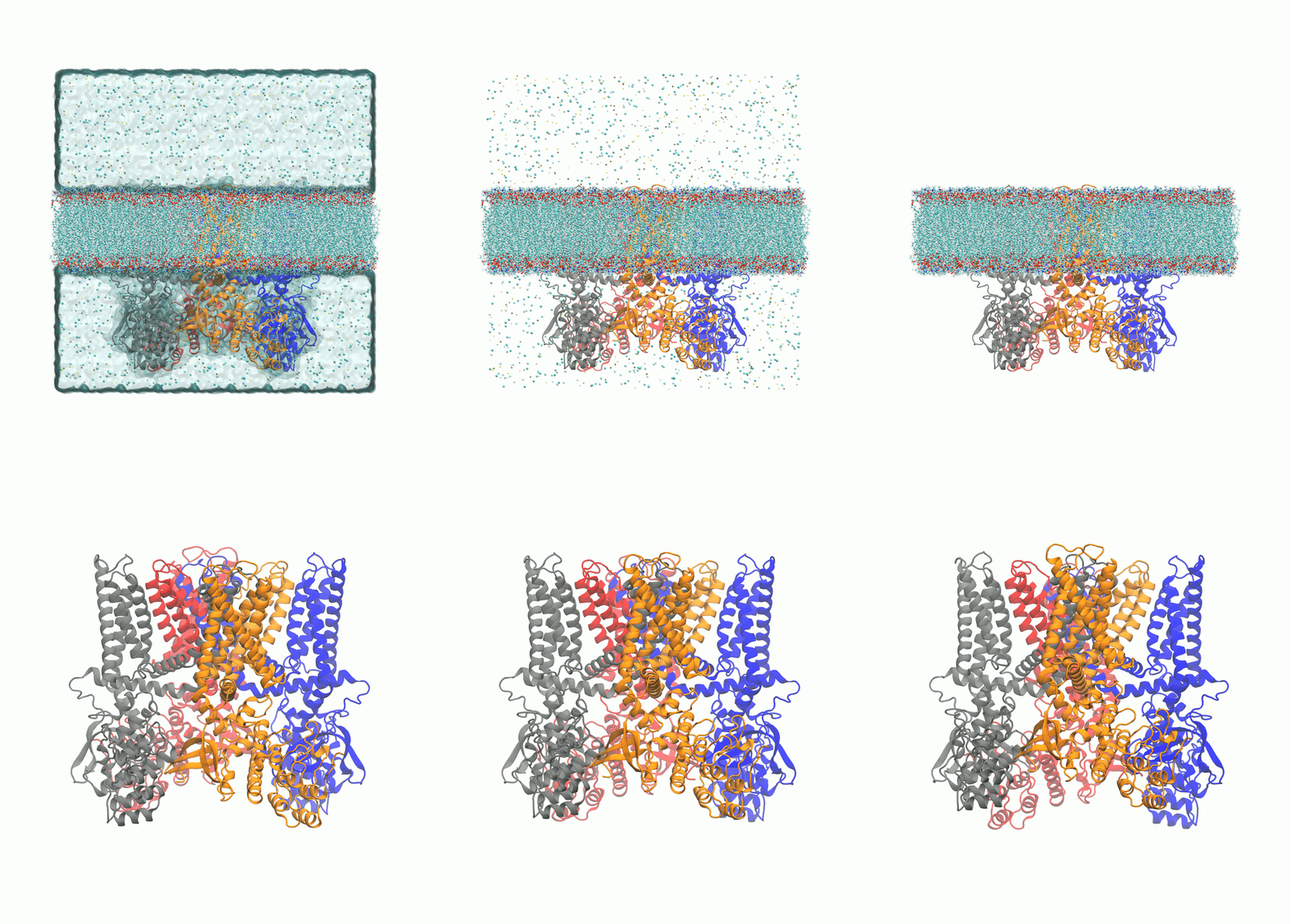
Investigation of Polymodal activity of TRPV1 ion channel.

The goal of the proposed research is to understand the polymodal activation of TRPV1, specifically its activation by heat, protons, and chemical ligands. Understanding the molecular mechanisms that underlie TRPV1 function has significant implications in human health. TRPV1 is a polymodally regulated ion channel that is activated by many diverse stimuli, including heat, protons (low pH), and chemical ligands, like capsaicin, the pungent vanilloid from chili peppers

Investigation of Polymodal activity of TRPV1 ion channel.
Molecular DynamicsBiophysicsThermodynamic EnsemblesCryoEMNMR

Timeline

2025–2027

Lead

Abhishek Singharoy, Wade Van Horn

Recent progress

  • Ongoing Simulations
ActiveEducational Platform Development

BioSense Network

BioSense Network develops virtual biotechnology and molecular simulation learning modules, teacher training, and an online platform to bring immersive biophysics education to diverse student populations.

BioSense Network
Structural BiologyHuman Computer InteractionMultiscale ModelingBiophysicsMolecular SimulationsSTEM Education

Timeline

2022–Present

Lead

Abhishek Singharoy

Recent progress

  • Developing virtual simulation-based biotechnology curriculum and an online learning platform.
ActivePublication and Learning-System Research

AI Tutor-Teammate Adaptability for Interactive Molecular Dynamics

This project explores artificial intelligence tutor-teammate adaptability to harness discovery curiosity and promote learning in the context of interactive molecular dynamics.

Human Computer InteractionApplied Deep LearningInteractive Molecular DynamicsAI TutoringLearning Systems

Timeline

2025–Present

Lead

Abhishek Singharoy, Caleb James Armstrong

Recent progress

  • Project publications added for AI tutor-teammate adaptability and interactive molecular dynamics.
ActiveAblation Studies

Biophysical Transformer

The goal of the Biophysical Transformer is to leverage physical notions of protein interactions as the basis for a language model, creating a joint physics-sequence space for downstream applications

Deep LearningBiophysicsElectrostaticsSE3 Convolutional Networks

Timeline

2025–2027

Lead

Abhishek Singharoy

Recent progress

  • Moved training to Wheat Supercomputers
ActiveHidden

Learning to Predict Ensembles of Protein Conformations from Molecular Dynamics Simulation Trajectories

Given the success of methods like bioemu, can we generate thermodynamic ensembles from sequence alone?

Deep LearningMELDThermodynamic EnsemblesMolecular DynamicsStructure Prediction

Timeline

2023–2026

Lead

Abhishek Singharoy, Tristan Bepler

Recent progress

  • Generated new datasets with MELD and did some energy calculations
ActiveModel Testing and Fine Tuning

NMR Automated Pipeline for Drug Analysis

The goal of the NMR automated pipeline is to take a sequence of 2D NMR spectra from titration of TRPV1 binding with compounds, and being able to do unsupervised and supervised learning methods for drug design.

NMRSVMApplied Deep LearningFeature ImportanceDrug Design

Timeline

2025–2027

Lead

Abhishek Singharoy, Wade Van Horn

Recent progress

  • Using adversarial techniques for drug design
ActiveComputational Study

Tacticity Effects on Polymer Backbone Scission

Tacticity, the stereochemical configuration of side groups along the backbone of a polymer chain, is known to affect thermal properties of materials. Computational methods are used to study how differing tacticity influences mechanical events such as backbone scission. Quantum mechanics principles are incorporated into classical molecular dynamics and also used standalone to simulate force pulling. Theoretical results guide experimental work such as ultrasonication and bulk mechanical analysis.

Polymer MechanicsMolecular DynamicsQuantum MechanicsMechanochemistry

Timeline

2025–2027

Lead

Abhishek Singharoy

Recent progress

  • Initial computational setup for tacticity-dependent scission underway.
  • Force-pulling simulations being analyzed.
ActiveIn-Vitro Validation

Mayo Moonshot (D3)

The goal of the D3 moonshot project is to create anti-dimerization binders for FGFR systems using state-of-the-art binder generation methods along with cutting edge simulation methods

Applied Deep LearningBiophysicsMELDThermodynamic EnsemblesBrownian Dynamics

Timeline

2025–2027

Lead

Abhishek Singharoy, Mitesh Borad

Recent progress

  • Finished generation of binders
  • Starting large-scale BD simulations for validation
  • Setting up wet-lab for protein purification
ActiveModel Testing and Fine Tuning

Disease Associations of HLA-class molecules from Learned Biophysical Representations

HLA-I has disease associations which can be revealed through biophysics. We hope to extend this work to HLA-II molecules.

Deep LearningBiophysicsElectrostaticsHealthcareImmunologyApplied Deep Learning

Timeline

2025–2027

Lead

Abhishek Singharoy

Recent progress

  • Finishing training on HLA-II embeddings, creating tests to compare against SOTA
ActiveCurrent Phase

Structural Relaxation of Membrane Super complex into Native States Enhances Light Harvesting Efficiency

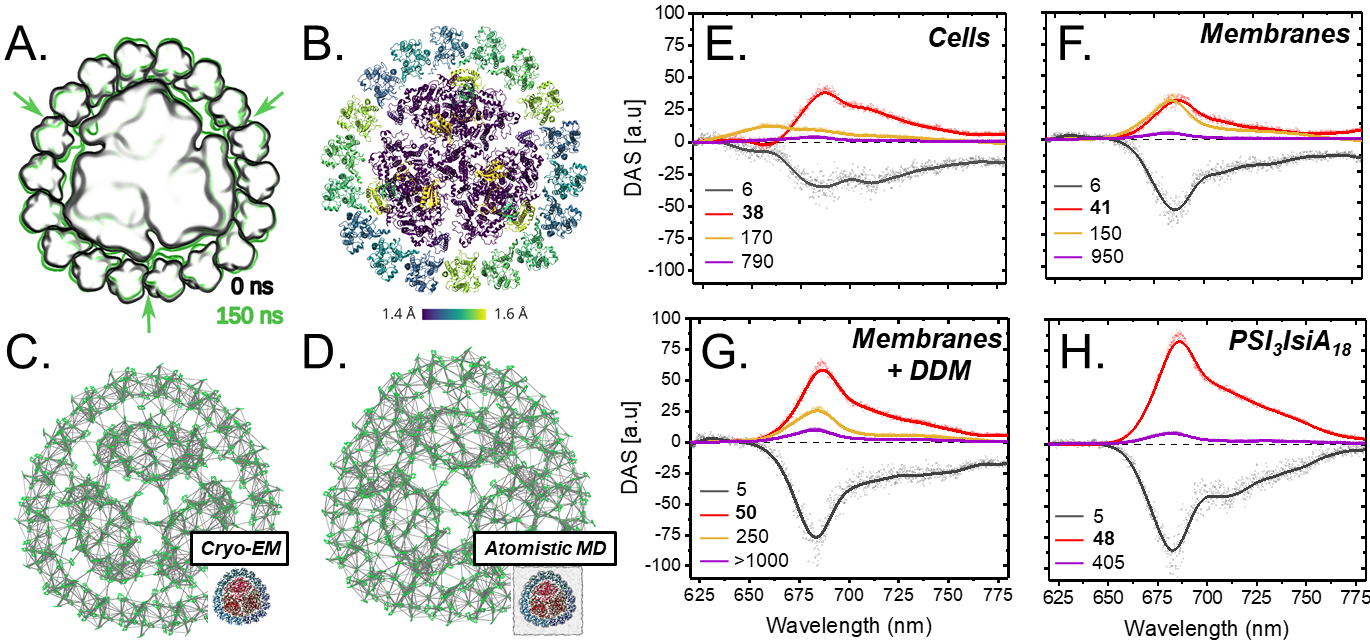
The aim of this project is to explore pigment protein complexes in photosynthesis in their native membrane embedded states through atomistic molecular dynamics simulations and experiment. Faster energy transfer measured for PSI-IsiA in membrane environment vs detergent solubilization. (A) Overlay of PSI–IsiA complex showing ring compaction over time during MD. (B) Root mean square fluctuations (RMSF) per protein subunit for PSI-IsiA supercomplex computed over the last 10 ns of simulation trajectory. (C) & (D) Excitonic Couplings of the super complex chlorophyll arrangements. Change in excitonic couplings (top 3000 couplings shown as lines) results in a reduction of average excitation lifetime from 67 ps (C) to 54 ps (D). (E-F) Decay Associated Spectra (DAS) obtained from different states of PSI-IsiA using a streak camera. Amplitudes obtained from global analysis of time resolved data are shown as dots together with their Fourier smoothened curves as lines. DAS from cells (E) grown in low iron conditions (-Fe) and their salt washed membranes (F). PSI-IsiA associated DAS are in red and show a lifetime of about 40 ps. Following detergent (DDM) addition (G) and isolation with sucrose gradient ultracentrifugation (H) the PSI-IsiA associated lifetime increases to approximately 50 ps
Structural Relaxation of Membrane Super complex into Native States Enhances Light Harvesting Efficiency
Structural BiologyComplex systems

Timeline

2024–2027

Lead

Yuval Mazor, Abhishek Singharoy